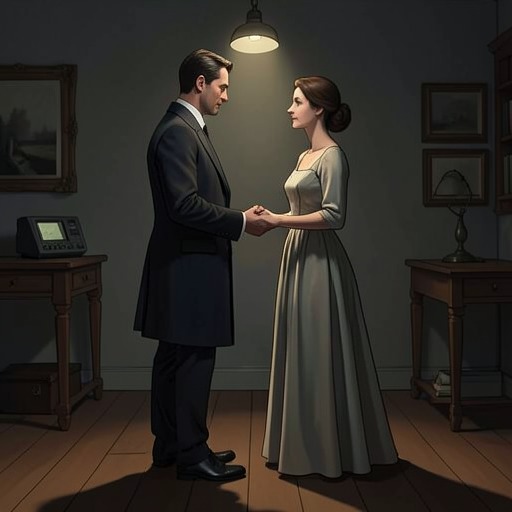
Della and Zaen’s reconciliation and engagement
One Thousand and One NightsDella and Zaen’s reconciliation and engagement turn a thousand unanswered proposals into a mutual commitment by changing what the proposal means: Zaen offers not another claim on Della but an enduring friendship, and Della accepts him without gold or jewels. Their resolution follows the lifting of Della’s curse, but its decisive work is emotional. Zaen’s bracelet persuades Della that he sees her as a person rather than a prize, allowing her to trust the love she had long refused to believe in.
Causes and Background
For years, Zaen had answered his affection with the same weekly gesture: a love letter accompanied by a marriage proposal. Della recalled that the letters began when she was six and Zaen seven, on the very week she learned to read while he had barely learned to write. The persistence continued through every kind of weather and occasion, and through every rejection. Its constancy could look like proof of devotion to Della’s companions; to Della, it was an irksome obligation she felt compelled to answer because of her rank.
Della did not regard the frequency of the proposals as evidence that Zaen understood her. She described them as the mistaken conviction of a man who had decided he was smitten, insisting that she had given him no reason to think highly of her and that they were only friendly acquaintances. Yet her own account included the regularity of their encounters and her expectation of his letters. A companion noticed the tension: Della spoke as if she and Zaen had never been apart, while rejecting him every time. The contradiction was not simply that she felt nothing; rather, familiarity and affection had not persuaded her that his courtship reached the person she understood herself to be.
The immediate circumstances changed after Tad told Zaen that Della’s curse had been lifted and advised him to try something different. Her danger had made the stakes of the case plain: Zaen’s account of the curse said that Della was beginning to lose her memory and would become the jinn’s property at twenty-one, with her inheritance passing to him. Once that threat was removed, the question of whether Della and Zaen truly loved one another remained unresolved. Tad could report that the curse was gone, but he could not determine Della’s feelings for her; he urged Zaen to change his approach rather than assume that the old one had worked.
What Happens
Zaen asks Della for a private audience and, at a stone fountain, begins by making room for her refusal. If she does not love him and never will, he says, he will leave her be. Before doing so, he wants to give her something. He draws an item from the pocket of his tattered trousers, takes Della’s hand gently, and places it in her palm. Della looks down, and a smile spreads across her face.
The gift is a friendship bracelet, assembled from tokens of their shared history rather than wealth. Zaen explains that its white horsehair recalls their first meeting, when Della got her first pony; red recalls the stallion that threw her and the moment Zaen caught her, which was also the first time she smiled at him. Black comes from the mare he gave her, chosen, he says, for a regal exterior and a beautiful, sweet spirit like Della’s. A bead for each of them bears their initials, carved by Zaen over many evenings. He had spent years looking for a gift good enough for her, but concludes that no quantity of gold or jewels could express what she means to him or the value he places on the time she comes for her daily ride. To him, the bracelet represents the real Della.
Della’s response identifies what the proposals had failed to communicate. She had taken their poetry and pretty words for insufficient proof of enduring love: Zaen spoke about how he saw her but had not shown that he knew how she saw herself. The bracelet changes that judgment because it records particular moments and makes their friendship, not her wealth or beauty, its subject. Della says she had wanted someone who would trust her with everything he did not have, and believe she could love him in return. Against the assumption that she was a spoiled person interested only in gold and jewelry, Zaen’s modest gift shows that he understands the person beneath that reputation.
From Courtship to Friendship
Della makes the terms of her acceptance explicit. The bracelet, she says, represents the person she wants to be to the man she marries: not a prize won through valiant effort, and not a trophy of his own greatness, but someone to be treasured always. She had resisted romance because she feared Zaen’s declarations were insincere and would not set her heart on a man who did not love the real her. Although their daily encounters gave her pleasure, she hardened her heart rather than let that pleasure become romance; she had never expected him to love her.
Zaen is surprised that she thought his love insincere, pointing out that he has proposed a thousand times. Della laughs: she had not realized he was counting, and, more importantly, romance was not the same thing as love. The exchange redefines the number that had organized their courtship. A thousand repetitions had made Zaen’s persistence visible, but repetition alone had not answered Della’s need to be known. The thousand-and-first attempt succeeds because it no longer treats persistence as a claim to be rewarded.
Zaen takes Della’s hand and says that he loves the real her, naming memories that belong to their shared life: the first time he saw her, and the time he caught her talking to her horse and jumping hedges when her mother was not looking. He says that he has loved her more with each passing day and calls the thousand-and-first attempt a bargain. Then he kneels by the fountain and asks her not merely to marry him but to be his friend for life. The change in the wording matters: where the earlier proposals could make Della seem like the object of a campaign, the new question makes lifelong friendship the foundation of marriage.
Consequences and Significance
Della accepts without gold or jewels, asking only that Zaen promise to be her dearest friend first and forever. Tears run down her face as she turns away to answer; Zaen pulls her into his arms and whirls her around, repeating his agreement. Their engagement resolves the long separation between Zaen’s declared devotion and Della’s distrust, not by asking her to submit to the force of his repeated proposals but by allowing her to name the relationship she wants.
The event gives the bracelet its full meaning. It is inexpensive beside the wealth Della is expected to inherit, yet its strands and beads hold the particular history that Zaen’s polished courtship had left unexpressed. The white, red, and black threads connect first meeting, rescue, and gift; the carved initials make the relationship reciprocal rather than a one-sided pursuit. Its value lies in its evidence of attention. By giving Della something that honors both her memories and her own sense of herself, Zaen demonstrates the trust and recognition she had been waiting for.
The engagement also completes the case’s movement from magical peril to personal choice. The jinn’s curse had threatened Della’s memory, identity, and inheritance, and its removal made a future possible without deciding whom she should love. Tad’s advice helps redirect Zaen, but the reconciliation itself belongs to Della and Zaen: he offers friendship instead of an entitlement, and she chooses marriage on terms that preserve her agency. The thousand proposals do not become meaningful simply because they reach a number; their final turn comes when the proposal changes from an attempt to win Della into a promise to treasure her as a friend.